
The Sugar Rush 1000 demo lets players explore Pragmatic Play’s candy-themed cluster slot without placing a real-money wager. It uses the same central structure as the paid version: a 7×7 grid, winning clusters of at least five matching symbols, cascading tumbles and multiplier spots that can increase after repeated wins.
Demo mode is useful for learning where wins form, how free spins are triggered and why the slot is classified as high volatility. It cannot prove that a betting system works or predict what will happen after switching to real money. Virtual-credit results are still random, and a short sequence of demo spins does not represent the game’s long-term return.
Sugar Rush 1000 Game Information
| Feature | Official game specification |
| Developer | Pragmatic Play |
| Release date | March 18, 2024 |
| Game format | Video slot |
| Grid | 7×7 |
| Win system | Cluster pays |
| Minimum winning cluster | Five adjacent matching symbols |
| Reel mechanic | Tumbles |
| Published RTP | 96.00% |
| Volatility | High |
| Maximum win | Up to 25,000× the stake |
| Multiplier spots | Begin at 2× and can double to 1,024× |
| Free spins | 10, 12, 15, 20 or 30 |
| Bonus trigger | Three to seven Scatter symbols |
Bet limits, bonus-purchase options and alternative RTP configurations can depend on the operator and jurisdiction. The information panel inside the active version should therefore be checked before real-money play.
What Is the Sugar Rush 1000 Demo?
The Sugar Rush 1000 demo is a free-play version of the slot that uses virtual credits rather than money deposited into a casino account. It allows the player to test the interface, adjust the stake, inspect the paytable and experience the tumble and multiplier systems without financial loss.
The demo normally follows the same visible game rules as the real-money version. Winning combinations, free spins and multiplier spots behave according to the game model, but any virtual balance or payout has no cash value.
The most productive use of demo mode is mechanical learning. It can show whether the slot’s pace is comfortable, how quickly the virtual balance changes and how difficult it may be to build multipliers on useful grid positions.
Demo play cannot establish that the game is “hot,” identify a profitable stake or show when the next bonus will land. Random results remain independent, and switching from virtual credits to a deposit does not continue a hidden winning sequence.
How Cluster Pays Replace Traditional Paylines
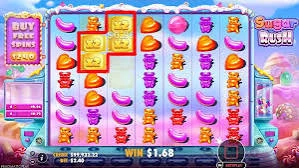
Sugar Rush 1000 does not require matching symbols to land across fixed horizontal paylines. A win forms when five or more identical paying symbols connect vertically or horizontally on the 7×7 grid.
Diagonal contact alone does not normally join two groups. Symbols need an adjacent vertical or horizontal connection to form one cluster.
After a winning cluster is evaluated, its symbols disappear. New symbols fall into the empty spaces from above, creating a tumble. If the replacement symbols form another valid cluster, the sequence continues without charging for another spin.
This matters because one paid spin can contain several consecutive winning tumbles. The sequence stops when no new cluster appears.
A common beginner mistake is watching only the first arrangement of symbols. The larger feature potential often develops through consecutive tumbles, particularly when wins repeatedly use positions that have already been marked by multipliers.
Multiplier Spots Drive the Main Upgrade
The defining change from the original Sugar Rush is the increased ceiling for multiplier spots. Whenever symbols in a winning cluster disappear, the positions beneath them become marked.
If another winning symbol later disappears on the same marked position during the relevant sequence, a multiplier is activated. It begins at 2× and can double through repeated qualifying wins:
2× → 4× → 8× → 16× → 32× → 64× → 128× → 256× → 512× → 1,024×.
When a winning cluster covers several multiplier spots, the applicable values are combined and applied to that win. This makes the location of a cluster important, not only the number of symbols it contains.
The 1,024× figure is a multiplier attached to an individual grid position. It is not a promise that every symbol landing there produces a 1,024× total payout, and it should not be confused with the slot’s maximum-win limit.
Base Game Versus Free Spins
During a normal paid spin, multiplier spots last only for the current tumble sequence. Once the sequence ends and a new paid spin begins, those marked positions reset.
During free spins, the marked positions and their multipliers remain on the grid between bonus spins. That persistence creates more time for the same cells to be used repeatedly and potentially increase toward higher values.
This is why the bonus round carries much of the slot’s larger-win potential. It is also why isolated base-game multipliers can feel less effective: the spin may end before another cluster lands on the required position.
How Free Spins Are Triggered
Three or more Candy Machine Scatter symbols trigger the Sugar Rush 1000 free-spins feature. The number of awarded spins increases with the number of Scatters:
| Scatter symbols | Free spins |
| 3 | 10 |
| 4 | 12 |
| 5 | 15 |
| 6 | 20 |
| 7 | 30 |
During the feature, every winning cluster can mark new positions or increase multipliers already present on the grid. Those values remain active until the bonus round ends.
Landing another three or more Scatters during free spins awards additional spins. A retrigger gives the player more opportunities to form clusters on developed multiplier positions, but it does not guarantee that useful symbols will land there.
The Scatter itself should not be treated as a predictable cycle. A long period without a bonus does not make the next spin more likely to trigger one. Continuing solely because the feature feels overdue is a form of loss chasing.
What the 96% RTP Actually Means
Sugar Rush 1000 has a published RTP of 96.00%. Return to Player is a theoretical long-term percentage calculated across a very large number of wagers. It does not mean that a player starting with 100 units should expect to leave with 96.
A 96% RTP corresponds to a theoretical house edge of 4%. Short sessions can finish with a result far above or below that average because the slot is highly volatile.
The game’s payout distribution is especially important. A significant part of the theoretical return can be linked to free spins, persistent multipliers and rare high-value sequences. A player may therefore experience many spins with small returns or no win while still playing a game whose mathematical RTP is 96%.
Demo mode does not provide enough evidence to confirm the RTP through observation. Even several thousand manual spins would be too small and uncontrolled a sample to reproduce the certified long-term model reliably.
High Volatility Changes the Budget Requirement
High volatility means Sugar Rush 1000 can produce uneven balance movement. Wins may be separated by dry stretches, while the largest potential payouts depend on less frequent combinations of features.
This does not mean the slot pays less often in every session, nor does it mean a large result becomes due after a losing run. Volatility describes distribution, not a predictable schedule.
The practical consequence is that the stake must be considered relative to the total budget. A balance of 100 units allows:
- 500 spins at 0.20 units;
- 100 spins at 1 unit;
- 20 spins at 5 units.
Those figures ignore any returns and simply show maximum gross exposure. They demonstrate why increasing the stake after a few empty spins can shorten a session dramatically.
For a high-volatility slot, lowering the stake usually provides more opportunities to observe the full mechanic. It does not improve the RTP or create safer results, but it reduces the amount committed to each random spin.
Can the Sugar Rush 1000 Demo Reveal a Winning Strategy?
No. The demo can teach the rules, but it cannot reveal a reliable Sugar Rush 1000 strategy because the next symbol arrangement is random.
Several observations from free play are often mistaken for patterns:
- a bonus appeared shortly after changing the stake;
- one symbol colour seemed to land repeatedly;
- a high multiplier followed several losing spins;
- the game appeared more generous after reopening;
- autoplay produced different results from manual spins.
These events may occur in a random sequence without indicating causation. The stake buttons, spin method and previous outcomes do not provide a forecast of the next grid.
A demo strategy should focus on understanding controls rather than testing profit. For example, the player can identify how wins connect, verify when multiplier spots reset and learn where the total bet is displayed.
When the session moves to real money, the useful controls are a fixed budget, a fixed stake range and a stopping point. None changes the house edge, but they limit the consequences of a losing sequence.
What to Check While Playing the Demo
A short demo session can answer several practical questions before money is involved.
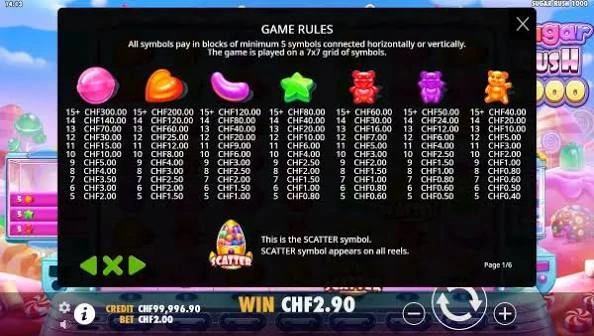
First, open the paytable and confirm how clusters connect. Players familiar with paylines sometimes misread disconnected groups as one win or overlook vertical connections.
Next, watch the multiplier positions after each tumble. Check when they appear, how they double and when they reset. The distinction between the base game and free spins becomes much clearer once the marked cells are observed directly.
The demo can also help assess:
- whether the animation speed is comfortable;
- how the balance changes at different stakes;
- how often manual spinning becomes repetitive;
- whether autoplay controls include useful limits;
- how retriggers affect the bonus;
- whether the game remains readable on mobile.
Do not use the virtual balance as a performance score. Demo credits may encourage larger stakes because the losses have no real consequence. Before real-money play, return the stake to an amount calculated from the actual entertainment budget.
Bonus Buy and Enhanced Feature Options
Sugar Rush 1000 may include bonus-buy or enhanced feature options in jurisdictions where such mechanics are permitted. Their availability and price can vary by market and operator.
A standard bonus purchase generally provides direct access to free spins for a multiple of the selected base stake. Enhanced versions may start the feature with multiplier spots already placed on the grid.
These options compress a large amount of exposure into one transaction. A purchase costing 100× a one-unit stake uses 100 units immediately, even though it appears as a single click rather than 100 separate spins.
Preloaded multipliers can improve the feature setup, but they do not guarantee that winning clusters will use those positions. A purchased bonus can return less than its cost or nothing meaningful at all.
Demo access to a bonus buy is useful for learning how the feature differs from a naturally triggered round. It should not be used to calculate expected profit from a handful of attempts.
Sugar Rush 1000 Compared With the Original
Both versions use a 7×7 grid, cluster pays, tumbles, Scatter-triggered free spins and marked multiplier positions. The main numerical difference is the multiplier ceiling.
| Feature | Sugar Rush | Sugar Rush 1000 |
| Grid | 7×7 | 7×7 |
| Minimum cluster | 5 symbols | 5 symbols |
| Tumbles | Yes | Yes |
| Base multiplier start | 2× | 2× |
| Maximum spot multiplier | 128× | 1,024× |
| Free spins | Up to 30 | Up to 30 |
| Published RTP | 96.50% | 96.00% |
| Maximum win | Lower than the sequel | Up to 25,000× |
Sugar Rush 1000 increases the upper multiplier potential while using a slightly lower published RTP than the original. That trade-off is more informative than calling the sequel automatically better.
Players who value larger theoretical feature potential may prefer Sugar Rush 1000. Those comparing purely by published RTP may favour the original. Neither version offers a predictable route to profit.
Common Errors to Avoid
| Error | Why it is misleading | Better approach |
| Treating 1,024× as a common payout | It is the maximum value of one multiplier spot | Check how multipliers combine with actual clusters |
| Raising the stake after empty spins | Previous spins do not affect the next grid | Keep the planned stake |
| Assuming a bonus is due | Scatter appearances are random | Stop at the session limit |
| Buying features repeatedly | Each purchase creates large immediate exposure | Set a separate purchase budget |
| Using demo winnings as proof | Virtual results do not predict real-money play | Use demo mode only to learn |
| Ignoring alternative RTP versions | Operators may offer different configurations | Check the in-game information |
| Letting autoplay run unchecked | Many wagers can occur quickly | Set spin and loss limits |
One non-obvious mistake is confusing a displayed payout with profit. If a spin costs 2 units and returns 1.20, it is recorded as a win by the game but leaves a net loss of 0.80.
Is the Sugar Rush 1000 Demo Worth Using?
The demo is worthwhile for anyone unfamiliar with cluster slots or multiplier spots. It shows how the reels tumble, why marked cells matter and how free spins differ from the base game without requiring a deposit.
Its value ends when virtual results are treated as evidence. The demo cannot identify the easiest betting level, a profitable time to play or a sequence that will continue after registration.
Use it to understand the controls, then assess the real-money version separately. Confirm the displayed RTP, maximum stake, feature-purchase cost and responsible gambling tools offered by the operator.
Sugar Rush 1000 is built around rare combinations of persistent multipliers and repeated cluster wins. That makes the slot visually clear but financially unpredictable. The best lesson available in demo mode is not how to beat it—it is how quickly the balance and features can behave differently from one random sequence to the next.